MVP vs. Full Product: The first thing that startups should build
An MVP allows companies to test core hypotheses, gather user feedback, and enter the market faster with minimal financial risk. Building a full product immediately often leads to wasted resources on unwanted features.
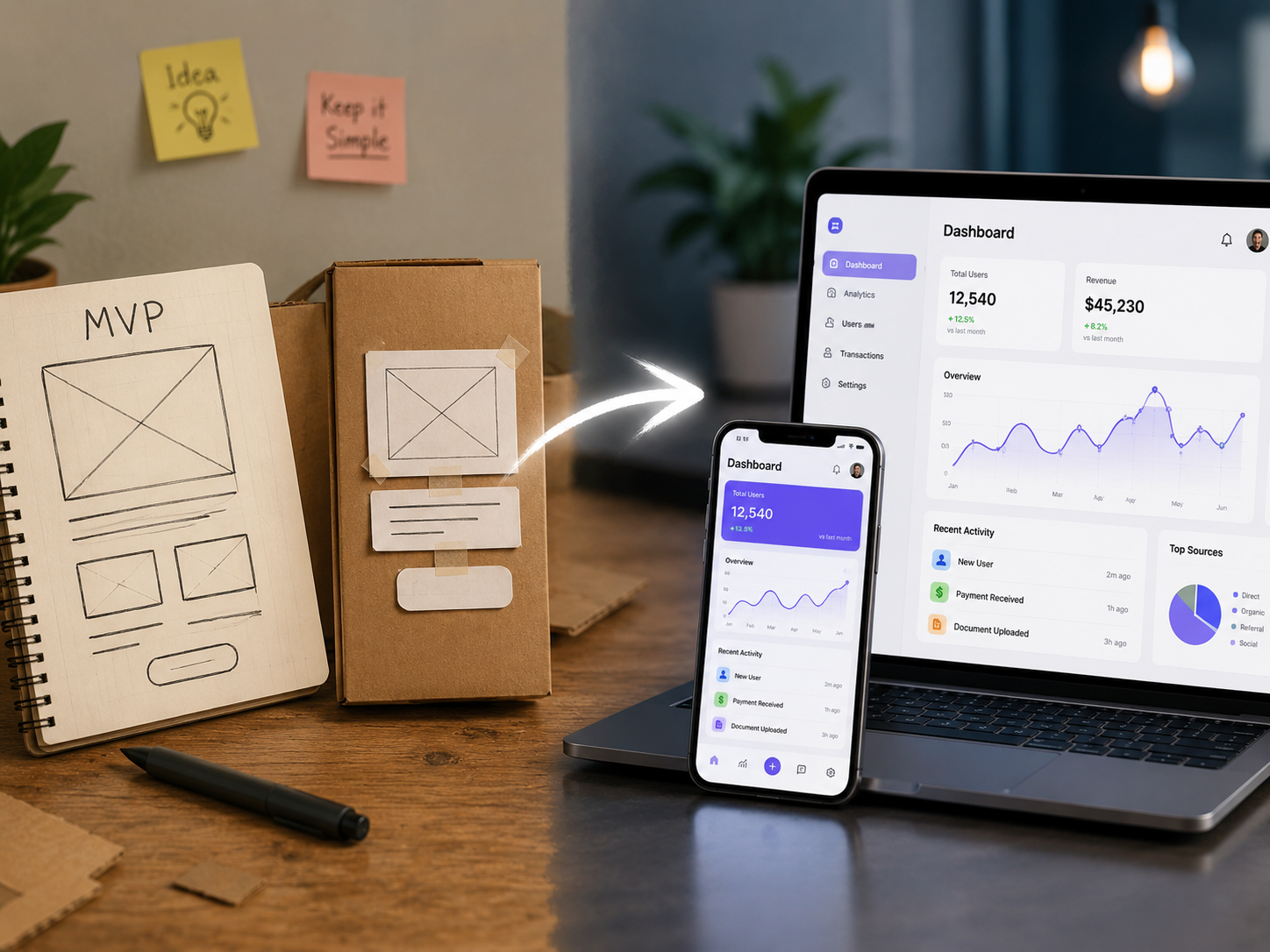
Startups should almost always build a Minimum Viable Product (MVP) first rather than a full product. An MVP allows companies to test core hypotheses, gather user feedback, and enter the market faster with minimal financial risk. Building a full product immediately often leads to wasted resources on unwanted features.
Every startup founder faces a critical decision early in their journey: launch quickly with a basic version of their idea, or wait until the software is perfectly polished and feature-complete. This debate between building a Minimum Viable Product (MVP) and a full product dictates how a company allocates its limited time, budget, and engineering resources.
Making the right choice can mean the difference between finding early product-market fit and running out of funding before acquiring a single paying customer. This guide breaks down the nuances of both development strategies, helping founders make informed decisions that align with sustainable growth and user needs. If you're also thinking about long-term scalability while planning your product, you can explore this guide on how to build a SaaS platform that can grow in 2026.
What is a Minimum Viable Product (MVP)?
MVP stands for "Minimum Viable Product." This is the simplest version of a new product that still gives early users what they need. The main point of an MVP is not to release a great app, but to get people learning as quickly as possible.
What are the main features of an MVP?
An MVP focuses exclusively on solving the primary problem for a specific target audience. It deliberately excludes secondary features, intricate design elements, and complex automations. Instead, it relies on the absolute essentials required to prove that users actually want the solution being offered.
What are the main reasons why you should start with an MVP?
Launching an MVP offers several strategic advantages for early-stage companies:
Faster time to market: Startups can launch in weeks or months rather than years.
Reduced financial risk: Companies spend less money validating their ideas, preserving capital for future iterations.
Early user feedback: Real-world usage data helps founders understand exactly what features customers value most.
Which successful companies started with an MVP?
Many billion dollar tech companies started with simple MVPs. In 2008, Dropbox validated its market demand with a simple explainer video before writing the complex synchronization code. Airbnb launched as a basic WordPress site offering air mattresses on a living room floor. Before making expensive full goods, these businesses made sure that people would pay for their core services.
What is the full product approach in startup development?
A full product is a complete, feature-rich release that gives the user a full experience from day one. This approach involves extensive planning, long development cycles, and rigorous quality assurance testing before the software ever reaches the public.
What are the advantages of building a full product first?
Releasing a highly polished application creates a strong initial impression. Users experience the software exactly as the founders envisioned it, without the bugs or missing features common in early MVPs. For established enterprises launching new divisions, a full product can help protect brand reputation.
What could go wrong if you skip the MVP phase?
For most startups, building a full product first is highly dangerous. The most significant risk is building something nobody wants. Founders spend months building sophisticated features based on assumptions, and then find that people don’t care about such functionalities. Additionally, full product development requires massive upfront capital, increasing the likelihood of a startup running out of money before securing product-market fit.
How do founders decide between an MVP and a full product?
Choosing the right development path requires analyzing your specific business environment. Founders must carefully evaluate several external and internal factors.
What factors dictate the product development strategy?
When deciding what to build, founders should evaluate:
Market landscape and competition: Entering a highly saturated market might require a more polished MVP to stand out against established players.
Available resources: Startups with limited funding and small engineering teams must lean toward an MVP to survive.
Business goals and vision: If the immediate goal is to secure venture capital, a functioning MVP with high user engagement is often more persuasive than a theoretical full product.
When should a startup choose an MVP?
An MVP is the optimal choice for the vast majority of software, SaaS, and consumer internet startups. If your business model relies on testing assumptions about user behavior, rapid iteration is mandatory.
When is a full product justified for early-stage companies?
For most software startups, making a full product isn't required, but in industries with a lot of rules, it is. For example, a medical technology startup developing surgical software cannot release a "buggy" MVP. Similarly, hardware startups developing physical consumer electronics often require a more comprehensive "full product" release due to the complexities of manufacturing and supply chain logistics.
How can startups successfully build and launch an MVP?
Building an MVP requires strict discipline. Founders must resist the temptation to add "just one more feature" before launching.
How do you identify core functionalities?
To define your core functionalities, identify the single biggest pain point your target audience faces.Ask yourself what the bare minimum needs to be in order to fix that problem.If a feature does not directly contribute to solving that specific problem, move it to the backlog.
What prioritization techniques work best?
Many product teams use the MoSCoW method (Must have, Should have, Could have, Won't have) to categorize features. For an MVP, engineers should exclusively build the "Must have" items. Everything else is scheduled for future updates.
How should teams handle iteration and feedback loops?
Once the MVP is live, the focus shifts entirely to user analytics and customer interviews. Startups should establish clear feedback channels, track user drop-off points, and use this data to dictate the next sprint cycle.
How do companies transition from an MVP to a full product?
An MVP is not a final destination. Once a startup validates its core concept, the engineering team must systematically evolve the software into a robust, scalable platform.
How does phased development work?
Transitioning to a full product happens gradually through phased development. Product managers release updates in small, manageable increments. This allows the startup to continuously deliver value without risking catastrophic system failures caused by massive, overarching code changes.
How should startups incorporate user feedback as they scale?
As the user base grows, feedback becomes more quantitative. Startups transition from conducting individual user interviews to analyzing large-scale product usage data. Feature requests should be prioritized based on how many paying customers demand them and how those features align with the company's long-term product roadmap.
What are the key scaling and growth considerations?
Moving toward a full product requires significant infrastructure upgrades. Startups must invest in cloud architecture, security compliance, and customer support systems capable of handling enterprise-level traffic. Technical debt accumulated during the MVP phase must be addressed before adding complex new layers to the application.
Strategic Product Development: Next Steps for Founders
The decision between an MVP and a full product sets the trajectory for a startup's entire lifecycle. While ambition drives innovation, practicality ensures survival. By starting with a focused MVP, founders can protect their capital, learn directly from their target market, and build a full product that actually solves real-world problems.