
Best Way to Automate Warehouse Inventory with AI in 2026
Discover how AI warehouse inventory automation can reduce stock errors, improve forecasting, automate reordering, and boost warehouse efficiency.
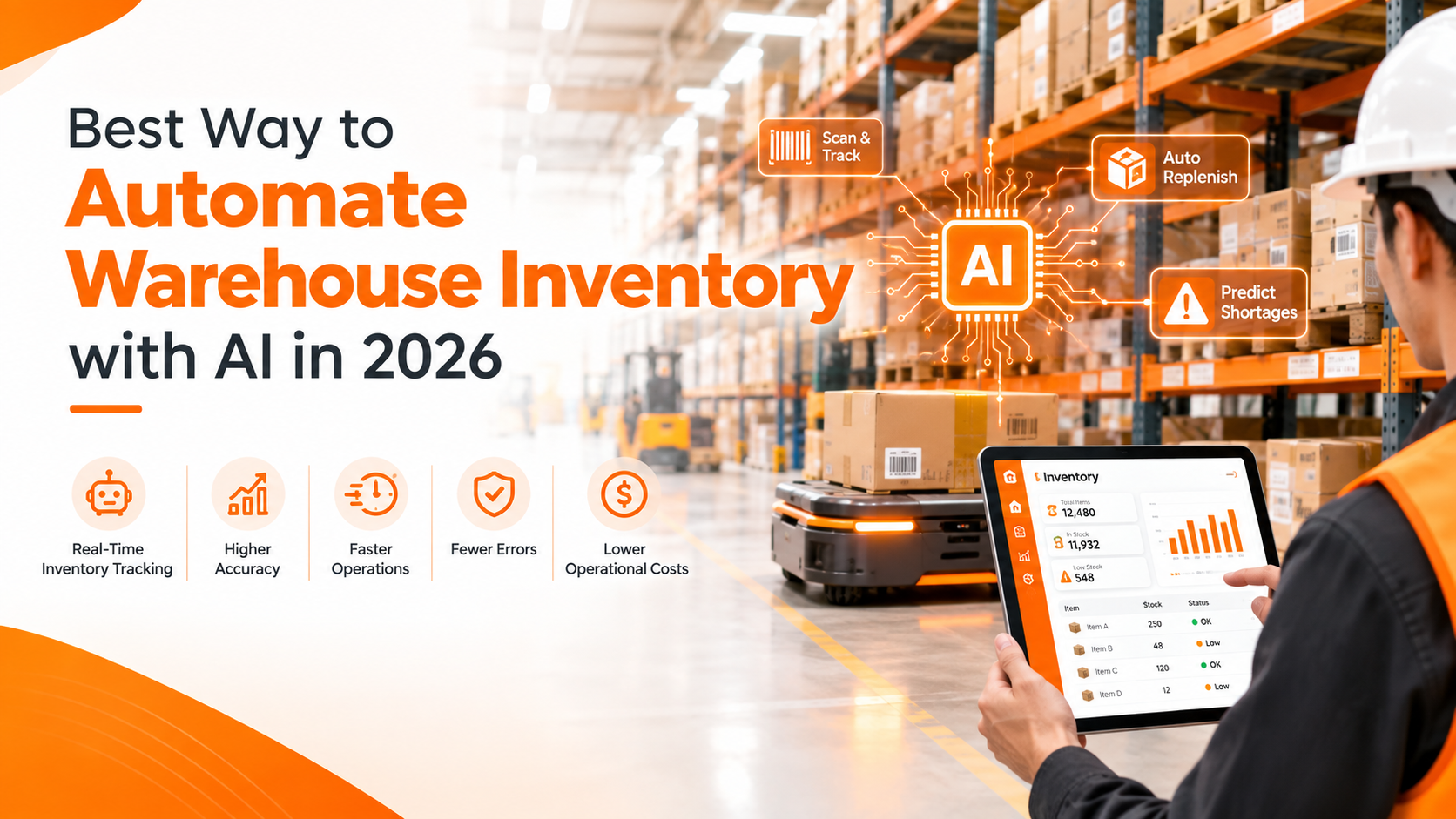
Inventory mistakes are quietly expensive. A miscounted pallet, a stockout during peak season, or a manual entry error can cost a mid-sized warehouse thousands of dollars a month and most operations teams don't find out until the damage is already done. That's why more logistics companies are choosing to automate warehouse inventory with AI instead of relying on spreadsheets, barcode scanners, and end-of-shift manual counts.
This shift isn't a future trend anymore. It's happening right now, across distribution centers of every size, because the cost of not automating has become harder to justify than the cost of adopting new technology.
Why Manual Warehouse Inventory Is Breaking Down
Traditional inventory management was built for a slower, smaller scale of operations. Today, it creates four recurring problems for warehouse teams:
Stock counts are always slightly out of date. By the time a manual count is completed and logged, new shipments have arrived, orders have gone out, and the numbers on paper no longer match what's on the shelf.
Human error compounds at scale. A single misread barcode or transposed digit might seem minor, but across thousands of SKUs, these small errors add up to inaccurate reorder points, overstocking, and costly stockouts.
Labor costs rise faster than inventory accuracy improves. Hiring more staff to count more frequently doesn't solve the underlying problem; it just spreads the same error rate across more people.
Seasonal demand spikes catch teams off guard. Without predictive visibility, warehouses either overstock (tying up cash in unsold inventory) or understock (missing fulfillment deadlines during peak demand).
How Businesses Automate Warehouse Inventory with AI
When a business decides to automate warehouse inventory with AI, the software typically handles four core functions that used to require constant manual attention:
Real-time stock tracking AI-connected sensors, RFID tags, and computer vision systems update inventory counts the moment stock moves, not hours or days later.
Demand forecasting Machine learning models analyze historical sales data, seasonality, and current trends to predict what needs to be reordered, and when.
Automated reorder triggers Instead of a warehouse manager manually checking stock levels, the system automatically generates purchase orders when inventory hits a predefined threshold.
Anomaly detection AI flags unusual patterns, such as unexpected shrinkage, misplaced stock, or slow-moving SKUs, so teams can investigate before small issues become expensive ones.
This is the real advantage: AI doesn't just digitize the old process, it removes the lag between "what's happening on the floor" and "what the system knows."
A Real-World Example: How One Dallas Warehouse Cut Errors by 60%
A mid-sized distribution center in Dallas, Texas, was managing inventory across 12,000 SKUs using barcode scanners and weekly manual audits. Despite a trained team, stock discrepancies were averaging close to 8% per cycle count, enough to cause regular fulfillment delays and unplanned rush orders.
After integrating an AI-driven inventory system with real-time RFID tracking and automated reorder triggers, the warehouse reduced discrepancy rates to under 3% within four months. Reorder decisions that used to take a manager 30–45 minutes of manual review were reduced to an automated alert with a one-click approval. The operations lead credited most of the improvement not to replacing staff, but to giving the existing team accurate, real-time data instead of outdated counts.
This kind of result isn't unique to Dallas; it reflects a pattern seen across warehouses that make the shift from manual to AI-driven inventory management.
Best Practices for Implementing AI Inventory Automation
Moving to AI-powered inventory management works best as a phased rollout rather than a single company-wide switch:
Start with your highest-risk SKUs. Prioritize the products with the highest sales velocity or the most frequent discrepancies to see fast, measurable ROI.
Integrate with existing systems. AI inventory tools should connect with your current WMS or ERP platform, not replace your entire tech stack overnight.
Train your team on exceptions, not just tools. The goal is for staff to review AI-flagged anomalies and make judgment calls, not to eliminate human oversight entirely.
Set clear accuracy benchmarks. Track discrepancy rates, fulfillment speed, and carrying costs before and after implementation so the impact is measurable.
Final Thoughts
Manual inventory management is reaching its limits as order volumes grow and customer expectations for fast, accurate fulfillment increase. Businesses that automate warehouse inventory with AI aren't just cutting costs, they're closing the gap between what's actually on the shelf and what the system says is there, which is where most fulfillment problems begin in the first place.
The warehouses seeing the biggest gains aren't necessarily the largest ones; they're the ones that started with a focused rollout, measured results, and scaled from there.
If your warehouse is still relying on manual counts and reactive restocking, the technology to fix that already exists the only real question is when to start.
Ready to see how AI can reduce errors and save hours in your warehouse operations? Contact us today for a free consultation and discover how automated inventory management can work for your business.